The clinic's books never balanced: how it went from the edge of collapse to over 95% accuracy
The story of a physiotherapist with two clinics in Rio who had already tried several systems, and what changed when the calendar and the finances became the same thing.

It was the same every month. After seeing the patients at both clinics, sorting out the staff schedule and putting out the day's fires, the owner sat down to close the books. And the books didn't close. What came into the till didn't match what the calendar said had been delivered. Money was missing or appointments were extra, and nobody could say where the difference was.
This is the case of a physiotherapist who owns two physiotherapy clinics in Rio de Janeiro and came to Soulf "about to lose it", in his words. We tell the story without his name, with the numbers he allowed us to use.
What he had already tried
He didn't arrive without having looked for a fix. He had been through several systems on the market: one for the calendar, one for finances, a spreadsheet in the middle to join the two. Each worked fine on its own. The problem showed up at the seams.
The calendar said the patient was seen on Tuesday. The finance system only knew about the payment if someone entered it by hand, and someone didn't always. Ten-session packages were paid once and used over weeks, and each system understood that differently. Each physiotherapist's commission depended on a calculation made at month end, from data that was already wrong.
When a clinic owner closes the month with fewer than half the appointments matching the till, he isn't making decisions about the business. He's guessing.
In the first conversation we measured it: fewer than 50% of bookings had a correct match in the finances. More than half of what happened in the clinics didn't show up properly in the money.
The diagnosis: it wasn't the finance system
The temptation is to swap the finance system for a better one. That had been done, and it didn't help. The problem wasn't in either system; it was in there being two.
Every time a piece of information has to be copied from one place to another, it can be copied wrong, late or never. In a clinic with two addresses, several professionals and dozens of appointments a day, "never" happens a lot.
What was done
The fix was to take the copying out of the path. Calendar, patients, records, professionals, finances, commissions and expenses moved into a single system, built on artificial intelligence and designed to run the clinic end to end.
In practice, what changed day to day:
- The booking creates the entry. When the session happens, the finances already know. A ten-session package is one payment with ten uses, and the system understands both.
- Commission comes from the appointment, not from a month-end calculation. Each physiotherapist sees what they've already produced.
- Expenses go into the same place, by category and by unit.
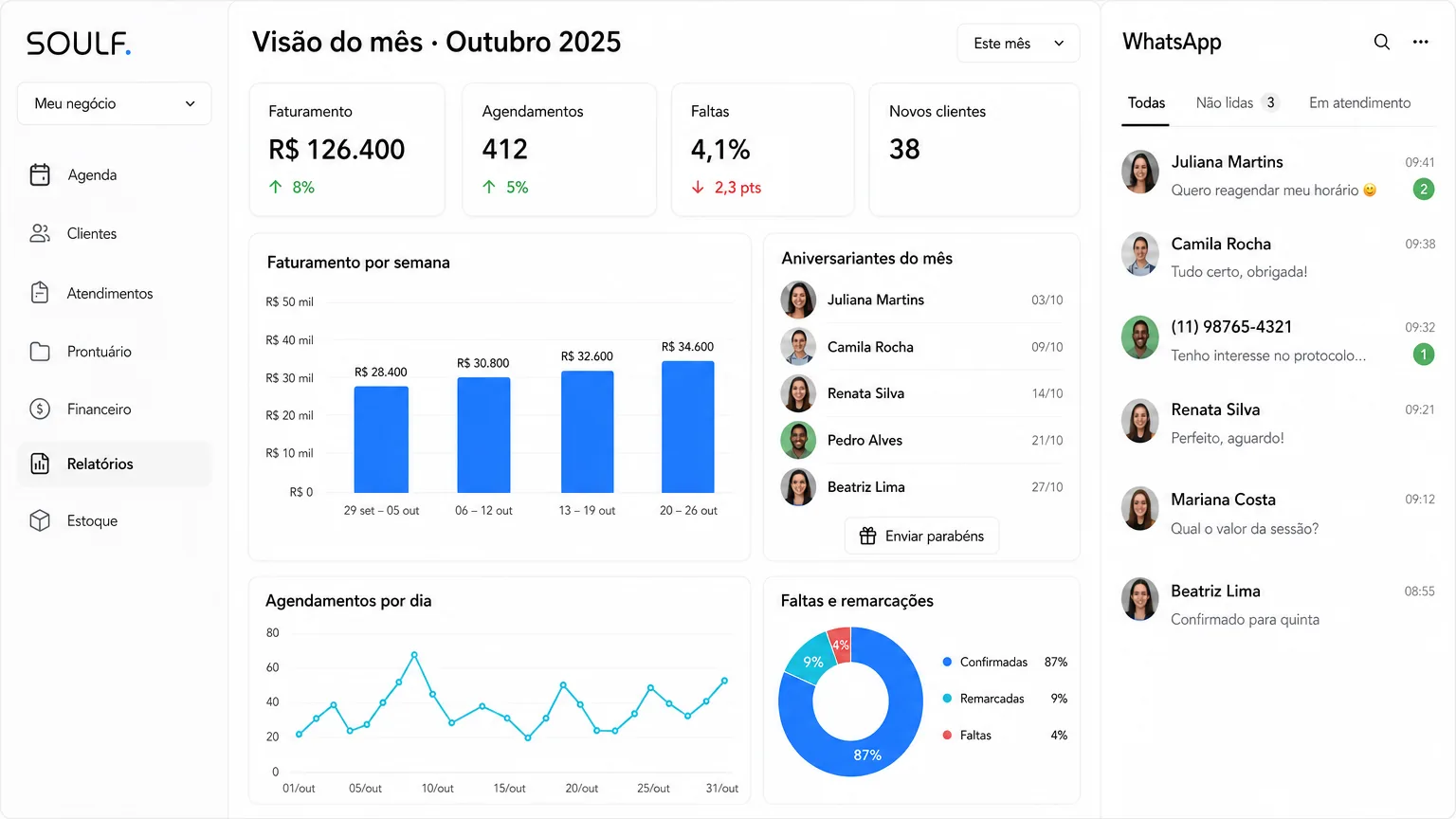
- Reports built for deciding, not for checking: revenue by unit, by professional, by type of service; what came in, what's receivable, where it's going out.
- A virtual assistant working from start to finish: it books and confirms patients on WhatsApp, and answers the owner questions like "how was the month at unit 2?".
 Read nextHow to cut no-shows at your clinic with automatic WhatsApp confirmations
What changed
Two numbers sum up the before and after.
From under 50% to over 95%. That's the match between what the calendar records and what the finances show. More than 95% of appointments now reconcile with the till without anyone checking. Month end stopped being an investigation.
Over R$ 4,000 a month on coffee. That was the number he saw in the first month, when expenses entered the same dashboard as revenue, by category. Nobody had noticed, because the spending was scattered across small purchases over weeks. Seen together, it was a significant cost for a clinic, and cutting it moved profitability without changing anything in patient care.
Three lessons for anyone in the same spot
- If closing the month depends on reconciliation, the problem is structural. Swapping the finance system for another won't fix it; the copying has to leave the path.
- Measure the match before changing anything. Take one month and count how many calendar appointments have a correct entry in the till. That number is your starting point.
- The first win usually comes from expenses, not revenue. When spending enters the same place, something hidden shows up. It's almost always faster to cut that than to sell more.
Founder of Soulf and Smart IT Consulting. Writes about applied AI for service businesses, WhatsApp service and management.